
That Settlement Offer Has Nothing to Do With What You Actually Lost

That Settlement Offer Has Nothing to Do With What You Actually Lost

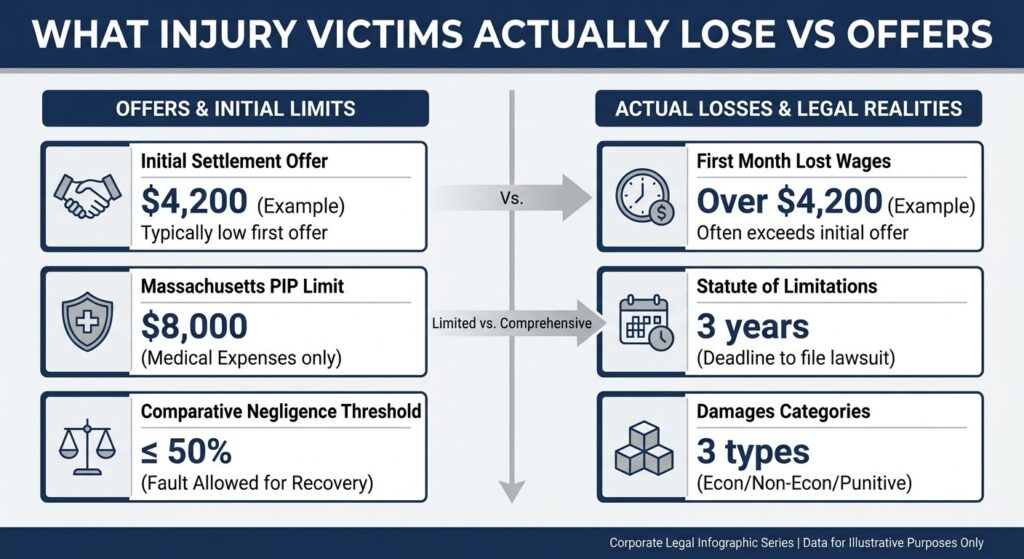
She called me on a Tuesday afternoon, about six weeks after a rear-end collision on Route 9. The adjuster had been “so helpful,” she said. Called within days, sent flowers to her hospital room—I’m not making that up—and had a check ready for $4,200 if she’d just sign a release. She hadn’t signed yet, but she was close. She had a herniated disc, two months of physical therapy ahead of her, and she hadn’t been back to work since the accident.

That $4,200 wouldn’t have covered her first month of lost wages.

I see this pattern constantly. Injured people in Massachusetts who don’t know what they’re actually entitled to, who mistake a fast offer for a fair one, and who don’t realize that signing that release closes the door permanently. So let me walk you through what compensation actually looks like under Massachusetts law—not what the adjuster wants you to think it looks like.

What You’re Actually Entitled To: The Full Picture

Massachusetts personal injury law divides recoverable damages into three categories. Most people have heard of two of them. Almost nobody fully understands all three until they’re sitting across from someone who’s spent years watching claims get undervalued.

Damage CategoryWhat It CoversHow Common
Economic damagesMedical bills, lost wages, future treatment costs, lost earning capacityEvery claim
Non-economic damagesPain and suffering, emotional distress, loss of enjoyment of lifeEvery claim
Punitive damagesPunishment for willful or malicious conductRare

Economic damages are the quantifiable losses—the ones with receipts and pay stubs attached. Medical expenses are the most obvious: emergency room bills, surgery costs, imaging, physical therapy, prescription medications, and any future treatment your doctors reasonably expect you to need. Lost wages cover income you couldn’t earn while recovering, and if your injuries affect your earning capacity long-term, that future loss is recoverable too.

Non-economic damages are where most of the confusion—and most of the money—lives. Pain and suffering. Emotional distress. Loss of enjoyment of life. The fact that you can’t coach your kid’s soccer team anymore, or that you wake up at 3 a.m. because your back won’t let you sleep. These are real losses. Massachusetts courts recognize them as real losses. But insurance companies work very hard to convince injured people that these damages are somehow speculative or inflated, because minimizing non-economic damages is how they protect their bottom line.

Punitive damages are rare in Massachusetts personal injury cases. They’re designed to punish defendants for conduct that’s especially egregious—not just negligent, but willful or malicious. What matters for most injured people is building the strongest possible case around economic and non-economic damages.

The distinction between these categories isn’t just academic. It shapes how you document your claim, what evidence you gather, and how you respond when an adjuster makes an early offer. As a personal injury lawyer massachusetts, I’ve watched people leave substantial non-economic damages on the table simply because they didn’t know those damages existed.

Economic Damages: What You Can Prove and How

Medical expenses and lost wages sound straightforward until you’re actually trying to document them.

The no-fault layer most people misread. Massachusetts operates under a modified no-fault insurance system. Massachusetts requires all drivers to maintain PIP coverage under Massachusetts General Laws Chapter 90, Sections 34M and 34N — it pays medical expenses and 75% of lost wages up to $8,000 per person per accident, regardless of fault. Bills get paid early, which creates a false sense that the claim is “handled.” PIP is a floor, not a ceiling. Bills get paid early, which creates a false sense that the claim is “handled.” PIP is a floor, not a ceiling. Once you exhaust PIP and meet the tort threshold, you can pursue the at-fault driver’s liability insurance for the full scope of your damages. Under Massachusetts General Laws Chapter 231, Section 6D, that threshold is met when medical bills exceed $2,000, or when the injury involves a fracture, loss of a body part or significant function, or permanent disfigurement. 

Lost wages require real documentation. Pay stubs, employer verification, tax returns if you’re self-employed. If your injury affects your ability to work in the future, you’ll likely need a vocational expert and possibly an economist to project that loss. Insurance companies will push back hard on future lost earning capacity claims—arguing your injury isn’t as limiting as you say, or that you could return to some form of work. This is where having organized records from day one matters enormously.

Future medical costs belong in your claim now. If your orthopedic surgeon says you’ll need a knee replacement in ten years because of this accident, that cost belongs in your claim today. You can’t come back later and reopen a settled case. Settling before you understand the full scope of your medical future is one of the most expensive mistakes I see—and one of the most preventable.

Non-Economic Damages: The Part Adjusters Hope You’ll Forget

There’s no formula that spits out a pain and suffering number. Anyone who tells you otherwise—including any online settlement calculator—is giving you false precision.

Here’s how these damages actually get evaluated:

  • Nature and severity of the injury — A spinal injury requiring surgery is valued differently than a soft tissue injury that resolves in six weeks. That’s not unfair; it reflects reality.
  • Duration of recovery — Longer recovery periods, especially those involving permanent effects, carry more weight.
  • Impact on daily life — What you can no longer do matters. Courts and juries respond to specifics, not generalities.
  • Consistency of treatment — Every appointment you skip, every treatment you delay, becomes ammunition for the adjuster.

Emotional distress, loss of consortium (the impact on your relationship with a spouse), and loss of enjoyment of life are all recoverable in Massachusetts. These aren’t soft concepts. They’re recognized categories of harm that courts take seriously. The challenge is presenting them in a way that feels concrete and credible—which is why the details in your own records, journals, and testimony from people who know you matter so much.

What is unfair is when insurance companies treat non-economic damages as a negotiating chip rather than a legitimate category of loss. They’ll point to gaps in treatment, argue you didn’t follow medical advice, or suggest your pain complaints are exaggerated. Consistent medical documentation is your answer to all of it.

Comparative Negligence: The Misconception That Costs People Money
“I can’t recover anything because I was partly at fault.”

That’s wrong. And it costs people real money when they believe it.

Massachusetts follows a modified comparative negligence rule. If you were partially responsible for the accident, your recovery is reduced by your percentage of fault—but you can still recover as long as you were not more than 50% at fault.

A simple example: A jury finds you 25% responsible. Your total damages are $100,000. You recover $75,000. Not zero.

The insurance company knows this. What they’ll try to do is argue your fault percentage is higher than it actually is, because every percentage point they add to your side of the ledger reduces what they owe. They’ll look at whether you were speeding, whether you were distracted, whether you failed to take some action that might have prevented the accident.

This is why what you say to an adjuster in those early conversations matters. Statements get used. Admissions get amplified. If you’re worried about being partly at fault, don’t let that fear push you into a premature settlement—or worse, into not pursuing a claim at all. Get a real assessment of the facts first.

The Statute of Limitations: A Deadline That Does Not Move

Three years from the date of the accident. That’s Massachusetts law for personal injury claims.

Three years sounds like a long time. Here’s what actually happens:

  1. The first several months go to medical treatment and getting back to some version of normal life.
  2. Then you start thinking about the claim.
  3. Then an adjuster keeps you engaged in “negotiations” that go nowhere.
  4. Then the deadline is approaching and you’re scrambling—or you miss it entirely.

I’ve had those calls. They’re the worst kind.

The three-year clock is a hard stop. With very limited exceptions—claims involving minors, or cases where the injury wasn’t immediately discoverable—courts won’t extend it. Filing even one day late means the defendant can have your case dismissed regardless of how strong it is.

There’s also a practical reason to move earlier rather than later: evidence degrades. Witnesses move or forget details. Surveillance footage gets overwritten. Accident scene conditions change. The strength of your claim is often highest closest to the accident, not three years later.

What the Insurance Company Is Actually Doing

That adjuster who called quickly and seemed so understanding? Their job is to close your claim for as little as possible. That’s not cynicism—it’s the business model. The faster they settle, the less they pay, because injured people who don’t yet know their full prognosis often accept less than their claim is worth.

A few tactics worth knowing:

  • Early offers almost never account for future medical expenses or full non-economic damages.
  • “How are you feeling?” is not small talk. It’s a question with a purpose, and your answer may be recorded or noted.
  • Broad medical authorizations let them search your records for pre-existing conditions to blame your injuries on.
  • Recorded statements get used to create inconsistencies between what you said early on and what you say later.

None of this means you can’t navigate a claim without a lawyer. Some people do. But understanding what you’re up against changes how you respond—and that changes what you recover.

Before You Do Anything Else

The to-do list is short but non-negotiable:

  • Document everything now. Medical records, bills, pay stubs, photos of your injuries, a daily journal of how you’re feeling and what you can’t do.
  • Don’t give a recorded statement without understanding what you’re agreeing to.
  • Don’t sign any release without knowing what you’re giving up permanently.
  • Don’t wait on the deadline while an adjuster strings you along with promises to “come up” on their offer.

First consultations with personal injury attorneys are typically free. Use that. Get a real assessment of what your claim is worth before you decide whether to settle, negotiate, or file suit.

The offer on the table right now may have nothing to do with what you actually lost. You deserve to know the difference before you sign anything.


Facebooktwitterredditlinkedinmail

Why a Trucking Company’s Legal Team Shows Up Before You Even Know What Hit You

Why a Trucking Company’s Legal Team Shows Up Before You Even Know What Hit You

The call I remember most clearly came at 11:47 p.m. A woman named Sandra was sitting in a hospital waiting room in Boston while her husband was in surgery. She wasn’t calling about his injuries. She was calling because a man had approached her an hour earlier—professional, calm, carrying a clipboard—and asked if she’d be willing to answer a few questions about the crash. He had a company logo on his jacket. He said he was there to “help document what happened.”

She had the instinct to say no. But she wasn’t sure if refusing would hurt them somehow.

She didn’t know that while she sat in that waiting room alone, a legal defense machine had already been set in motion. That’s the gap I keep trying to close.

What You Assume vs. What Is Actually Happening

Most people assume the period right after a crash is chaotic and disorganized for everyone involved. You’re dealing with emergency responders, police, medical staff. You assume the trucking company is doing the same—scrambling, waiting, figuring things out.

They are not scrambling. They have a protocol.

Large trucking companies and their insurers maintain rapid-response legal teams whose entire purpose is to mobilize within hours of a serious crash. Not days. Hours. By the time a family member is still trying to reach a hospital or understand a diagnosis, the other side has already made calls, dispatched personnel, and begun building a record. That’s not speculation—it’s a documented industry practice, and I watched it operate from the inside for years before I switched sides.

The man with the clipboard in Sandra’s waiting room wasn’t there to help. He was there to gather information that would later be used to minimize what the company owed her husband.

The First 24 Hours: A Tale of Two Timelines

The defense advantage compounds with every hour that passes. Here’s what’s actually happening in parallel during those critical first hours.

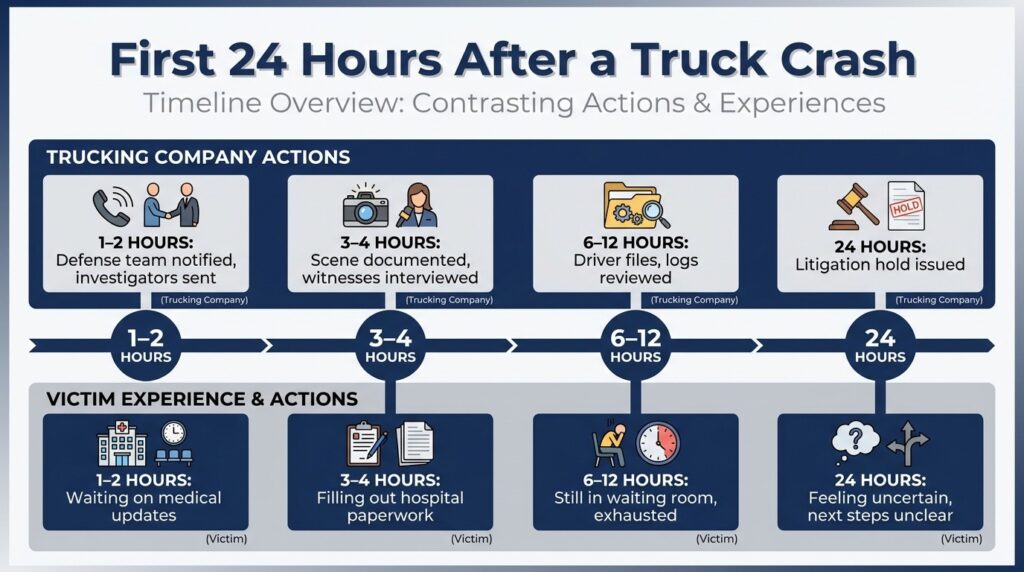
TimeframeWhat the Trucking Company Is DoingWhat Most Victims Are Doing
Hours 1–2Notifying insurer and defense counsel; dispatching investigators to the sceneWaiting for updates from surgeons; calling family
Hours 3–4Photographing skid marks, debris, road conditions; interviewing witnessesTrying to understand a diagnosis; filling out hospital paperwork
Hours 6–12Pulling driver personnel files; reviewing hours-of-service logs; assessing legal exposureExhausted, frightened, possibly still in the waiting room
Hour 24Internal litigation hold issued; narrative under constructionBeginning to wonder what comes next

Crash fatality data from NHTSA shows large trucks were involved in over 5,700 deaths in a single year—which is precisely why post-crash reconstruction has become a sophisticated, well-funded discipline on the defense side. The investigators arriving at that scene aren’t neutral. They’re documenting conditions in a way that supports the narrative most favorable to their client.

That asymmetry is the whole problem.

The Tools They’re Using—and Why Each One Matters to You

Understanding the specific instruments of the defense playbook helps you see what’s actually at stake with each one.

Electronic Logging Devices (ELDs)

These are among the most critical pieces of evidence in any serious trucking case. Since 2017, federal regulations have required interstate commercial drivers to use ELDs to record their hours of service. These devices capture whether a driver was fatigued, whether they violated hours-of-service rules, and exactly where the truck was and how fast it was moving.

The defense team knows this data exists. They access it immediately. If it’s damaging, it becomes something to manage rather than disclose voluntarily.

The Digital Paper Trail

The driver’s cell phone records, dashcam footage, and onboard computer data tell similar stories. Defense investigators secure these before anyone asks for them—and before anything can be accidentally overwritten or lost. This isn’t aggressive lawyering. It’s standard procedure. The problem is that it’s standard procedure on only one side of the case.

Insurance Adjusters

They are the human face of this process, and they’re often the first contact victims receive. They may sound sympathetic. They may say they just want to understand what happened.

What they’re actually doing is gathering statements, assessing your credibility, and looking for inconsistencies they can use later. The recorded statement you give in a hospital room—while you’re medicated and frightened—can follow your case for years. Speaking to an adjuster before consulting an attorney is one of the most common and costly mistakes injured people make.

Specialized Defense Counsel

Legal defense teams in trucking cases aren’t generalists. They’re specialists who handle these cases constantly. They know the federal motor carrier regulations, the evidentiary pressure points, and exactly how to frame a narrative that shifts blame or minimizes damages. If you’re working with a boston truck accident lawyer who handles these cases regularly, you have someone who knows the same playbook from the other direction.

Without that, you’re reading a chess board without knowing what the pieces do.

Evidence Preservation: The Window That Closes Fast

Here’s where the information gap becomes genuinely dangerous.

Federal regulations do require commercial carriers to preserve crash-related documents for at least one year for serious crashes, as outlined in federal crash recordkeeping rules. But “preserve” under those rules doesn’t mean the same thing as “make available to you.” And not all evidence falls under mandatory retention periods.

Dashcam footage can be overwritten within days if the system isn’t specifically instructed to preserve it. Onboard computer data has similar vulnerabilities. Witness memories fade. Physical evidence at the scene degrades or gets cleared.

The tool that counters this is an evidence preservation letter.

Sometimes called a spoliation letter, this document is sent by an attorney to the trucking company, its insurer, and any related parties. It formally notifies them that litigation is anticipated and demands they preserve specific categories of evidence. Under the Federal Rules of Civil Procedure, once litigation is reasonably anticipated, a party must preserve electronically stored information—and sanctions for destroying evidence can range from additional discovery orders to instructions that tell a jury to assume the missing evidence was harmful to the defendant.

That letter changes the legal landscape. It creates obligations. It puts the company on notice that someone is paying attention.

But it has to be sent quickly—ideally within days of the crash, not weeks. This is one of the most concrete reasons why early legal consultation matters. Not because you’re committing to a lawsuit. Because certain protective steps have windows that close.

Two Objections I Hear Constantly

“I don’t want to be litigious. I just want to be treated fairly.”

That’s completely understandable. But wanting fair treatment and understanding the process that determines whether you get it aren’t in conflict. The trucking company isn’t waiting to see if you’re litigious before they protect themselves. They’re protecting themselves regardless. Knowing what they’re doing isn’t about being adversarial—it’s about not being unprepared.

“I can’t afford a lawyer right now.”

Most people don’t realize that plaintiff-side attorneys in trucking cases work on contingency—meaning no hourly fees, no upfront costs. You pay nothing unless there’s a recovery. That structure exists specifically because injured people shouldn’t have to choose between medical bills and legal protection. The financial barrier people assume exists often doesn’t.

Your Immediate Checklist

If you or someone you love has been in a crash involving a commercial truck, the following steps matter right now—not next week.

  1. Do not give a recorded statement to anyone from the trucking company or their insurer before speaking to an attorney.
  2. Write down everything you remember about the crash while it’s fresh—time, location, road conditions, what the driver said or did.
  3. Photograph your injuries and any property damage as soon as you’re physically able.
  4. Preserve all communications you receive from the company or their representatives. Save voicemails. Screenshot emails and texts.
  5. Consult with an attorney who handles trucking cases specifically—not to commit to litigation, but to understand what’s already been set in motion on the other side and what steps, like an evidence preservation letter, need to happen fast.

One Last Thing

Sandra’s husband survived his surgery. She called back two weeks later, after she’d spoken with an attorney. By then, some of the early-window evidence was already gone—but not all of it. Enough remained to build a real case.

She asked me why no one had told her any of this before.

I didn’t have a good answer. The information exists. The playbook is documented. But it lives in legal circles, not in hospital waiting rooms where the people who need it most are sitting alone at midnight, wondering if they should talk to the man with the clipboard.

The trucking company didn’t wait. You shouldn’t either.

Facebooktwitterredditlinkedinmail

Negligence: What You Have To Prove To Win A Personal Injury Lawsuit

Understanding The Legal Concept Of Negligence

Negligence is the foundational principle of most personal injury lawsuits. It arises when someone fails to exercise reasonable care, resulting in harm to another person. Understanding what constitutes negligence is crucial for anyone considering legal action after an accident or injury. Courts require that specific elements be demonstrated to hold the responsible party accountable and secure compensation for damages suffered.

Proving A Duty Of Care Was Owed

The first step in a negligence claim is showing that the defendant owed you a duty of care. This means there was a legal obligation for the party to act reasonably to avoid hurting others. For example, drivers must operate their vehicles responsibly, while businesses must keep their premises safe. In personal injury lawsuits, establishing this duty is essential for your case to move forward, as it sets the foundation for legal responsibility.

Establishing Breach Of Duty By The Defendant

Once a duty of care is proven, you must demonstrate that the defendant breached this duty. A breach occurs when the person fails to meet expected standards, such as ignoring traffic laws or neglecting to clean up hazards. Courts look for evidence that the defendant’s actions were careless, reckless, or below societal norms. Proving a breach is a critical step that can make or break personal injury lawsuits.

Showing The Connection Between Breach And Injury

A successful personal injury lawsuit requires showing causation—that the defendant’s breach directly led to your injuries. This involves proving a clear link between their actions and the harm you suffered. Medical records, accident reports, and witness testimony are typically used to establish this connection. If there’s doubt about whether the breach caused your injury, your claim may be challenged or even dismissed.

Demonstrating Quantifiable Damages Or Losses

Finally, you must provide evidence of actual damages, such as medical expenses, lost wages, pain, or emotional suffering. The court needs proof that you sustained real losses due to the defendant’s negligence. Receipts, medical bills, and expert testimony can all substantiate your claim. The amount and nature of damages play a significant role in determining the compensation awarded in personal injury lawsuits.

Role Of Legal Guidance In Proving Negligence

Successfully proving negligence involves complex legal maneuvering and gathering persuasive evidence. Consulting an experienced personal injury attorney can greatly enhance your chances of winning a lawsuit. Lawyers help assemble documentation, navigate legal procedures, and advocate for rightful compensation. With the right guidance, injured parties can effectively prove negligence and pursue justice for the harm they’ve endured.

Facebooktwitterredditlinkedinmail